The first thing that trips up a Thailand itinerary is a sense of distance. Plan on the assumption that Bangkok and Chiang Mai are close because they are in the same country, and you lose a whole day to getting there.
Thailand runs about 1,600km from north to south — longer than the main island of Japan. The country is shaped like a long strip, so a trip from one end to the other is closer to an international flight than a domestic hop.
Getting a feel for the distances
Distances and rough travel times from Bangkok. Times vary with traffic and with the service, so they are given as ranges.
| Destination | Straight-line distance | By air | Overland / rail |
|---|---|---|---|
| Ayutthaya | 70km | — | Train 1.5–2h / car 1.5h |
| Pattaya | 100km | — | Car or bus 2–2.5h |
| Ko Samui | 475km | about 1h10 | Flight + ferry 3.5–4h |
| Chiang Mai | 580km | about 1h20 | Night train 12–13h / bus 9–12h |
| Krabi | 655km | about 1h20–1h30 | — |
| Chiang Rai | 690km | about 1h30 | — |
| Phuket | 695km | about 1h30 | Bus 11.5–16h |
These are straight-line distances. Roads detour around mountains and bays, so the driving distance runs 20–30% longer: Chiang Mai is about 690–750km by road, Phuket about 820–850km.
To put it in familiar terms: Bangkok to Chiang Mai is about 580km in a straight line — roughly London to Glasgow. Phuket is further still, about 695km, which is close to Paris to Marseille.
There is no high-speed rail. Covering these distances overland takes considerably longer than the map suggests.
What you can take depends on where you are going
The options narrow or widen with the destination. From Bangkok:
| Destination | Arrival airport | Rail | Bus |
|---|---|---|---|
| Chiang Mai | Chiang Mai International (CNX) | Northern Line terminus | Mo Chit 2 |
| Chiang Rai | Chiang Rai International (CEI) | — | Mo Chit 2 |
| Phuket | Phuket International (HKT) | — | Sai Tai Mai |
| Krabi | Krabi International (KBV) | — | Sai Tai Mai |
| Ko Samui | Samui (USM) | — | Sai Tai Mai + boat |
| Ayutthaya | — | Northern Line | Mo Chit 2 |
| Pattaya | U-Tapao (UTP) | Eastern Line, 1–2 a day | Ekkamai |
The three letters in brackets are the airport codes. Booking sites and boarding passes usually show the code rather than the name, so it is worth knowing them. On the Bangkok side, Suvarnabhumi is BKK and Don Mueang is DMK.
There are no scheduled flights from Bangkok to Pattaya's U-Tapao airport. At roughly two hours by road, the route does not work as an air service. U-Tapao is useful in the other direction: flying from Pattaya straight to Phuket, Samui or Chiang Mai. The airport itself is 40–50km from central Pattaya, about an hour by car.
How far the airport sits from town varies. Chiang Mai is about 4km out, Chiang Rai 8km and Krabi 15km — twenty minutes or less by taxi. Phuket's airport, by contrast, is at the north end of the island, about 32km from Phuket Town and further still from most of the beaches. Samui is 10–15 minutes from Chaweng.
Destinations outside this table have airports too. Trat (TDX) serves Ko Chang, and Sukhothai (THS) the historical park — both owned and operated by Bangkok Airways. Hat Yai (HDY) in the far south is the gateway towards Malaysia, and Udon Thani (UTH) in the northeast towards Laos.
Bus terminals are split by direction: Mo Chit 2 for the north and northeast, Sai Tai Mai for the south, Ekkamai for the east and Pattaya. Which terminal you leave from can change your travel time on the day by an hour or more. Once the destination is set, check which terminal goes with it.
To reach Samui by sea, travel to Surat Thani and pick up a ferry at Don Sak on the mainland coast.
The long-distance station changed in 2023
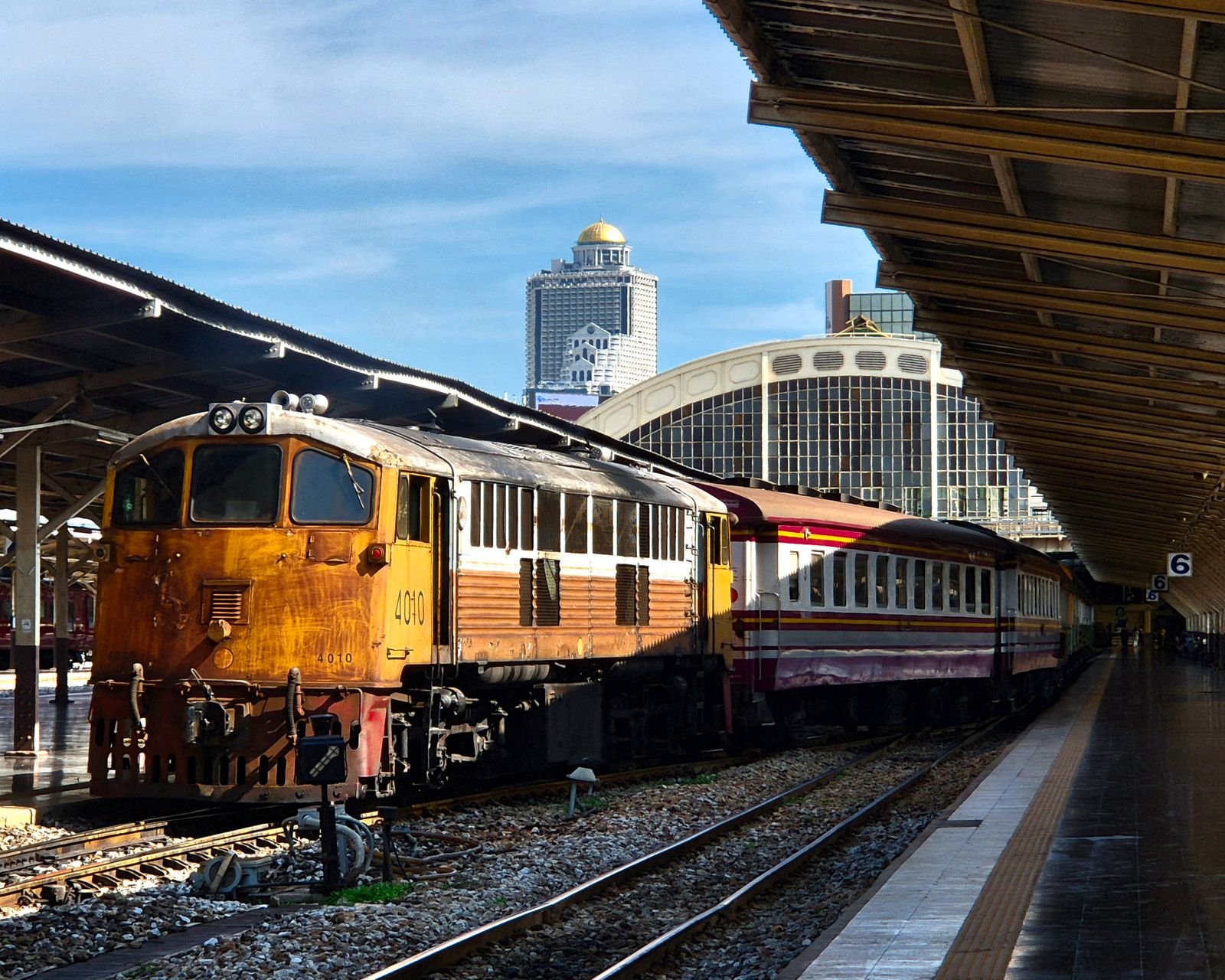
If you are taking the train, long-distance services on the Northern, Northeastern and Southern Lines have started from Krung Thep Aphiwat Central Terminal (Bang Sue) since January 2023. Hua Lamphong, the former terminus and the station in the photo at the top of this article, remains in use for commuter services and the Eastern Line.
Older guidance still says long-distance trains leave from Hua Lamphong. For Ayutthaya or Chiang Mai by rail, the station you want is Krung Thep Aphiwat.
Ko Samui's airport is a special case
Samui Airport was built, and is owned and operated, by Bangkok Airways, which also owns the airports at Sukhothai and Trat. Most Thai airports are run by the state-owned AOT or by the Ministry of Transport's Department of Airports; Samui sits outside both.
It is not a complete monopoly — other carriers do serve it — but the airline operates the majority of flights. Fewer airlines able to use the airport means fewer options for you. If your dates are fixed, book early.
By sea, the mainland side is concentrated at Don Sak, from where several ferry operators run to the piers on Samui.
Flight time is not what decides your day
Domestic flights in Thailand take roughly an hour to an hour and a half, wherever you are going. Read only that number and a "fly in the morning, sightsee after lunch" plan looks reasonable. It rarely works out.
The real total is the sum of:
- Getting to the airport (about 30 minutes to Suvarnabhumi by rail; 40 minutes to two hours by bus)
- Airport procedures (two hours before departure is the usual guidance for domestic; the counter closes 40 minutes before)
- The flight itself (1–1.5 hours)
- Getting from the arrival airport into town
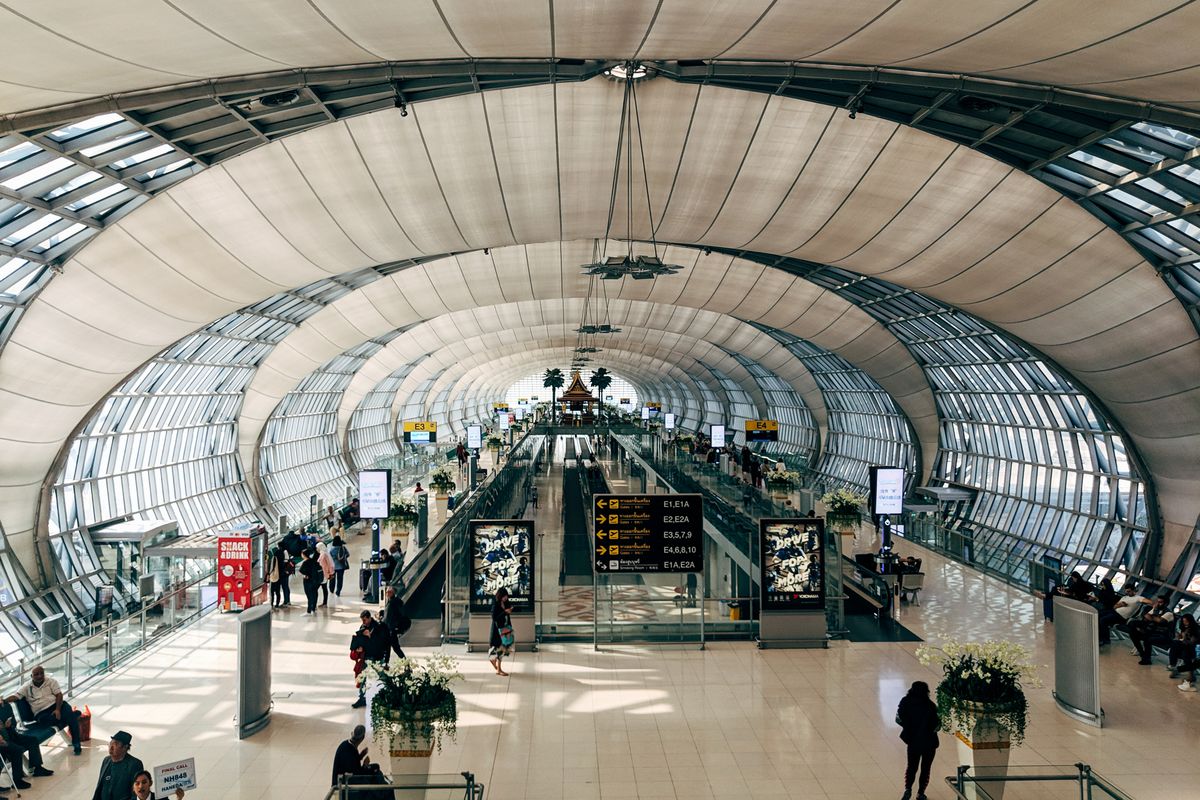
A flight of 1 hour 20 minutes becomes something like five hours door to door. Hit traffic and another hour goes on top. Treat a travel day as half a day gone and the plan will survive contact with reality.
Two airports, and which one is not fixed
Bangkok has two airports with different roles.
Suvarnabhumi (BKK) handles international traffic and the full-service carriers. In 2017 it served around 49.5 million international passengers against roughly 11.3 million domestic.
Don Mueang (DMK) is the low-cost carrier base — Thai AirAsia, Nok Air, Thai Lion Air. Terminal 1 is international, Terminal 2 domestic.
These are not two terminals of one airport; they sit on opposite sides of the city. If you arrive internationally at Suvarnabhumi and continue on a domestic flight from Don Mueang, that transfer is a journey in itself. Do not budget a short connection for it.
For the trip into town, the Airport Rail Link runs from Suvarnabhumi to Phaya Thai in about 30 minutes, and the SRT Dark Red Line from Don Mueang to Bang Sue in about 20. Taxis depend entirely on traffic: Don Mueang to the centre is about 40 minutes when clear and over an hour when it is not.
The same destination often has flights from both. Broadly, full-service carriers use Suvarnabhumi and low-cost carriers Don Mueang, but that mapping is not fixed. Airlines do move whole groups of routes between the two, and it changes by route and by period.
Booking sites sometimes show the origin simply as "Bangkok". Confirm the airport code — BKK or DMK — before you complete the booking. Get it wrong and you are crossing the city to the other airport.
The night train and night bus buy you a hotel night
Sleeper trains run from Bangkok to Chiang Mai in 12 to 13 hours — far slower than flying. People still take them because you travel overnight and arrive in the morning, so the journey and the hotel night occupy the same hours.
Sleepers come in classes. First class is a lockable two-berth compartment; second class is an open carriage where seats are converted to berths by an attendant in the evening, separated only by curtains. If you want quiet, that means first. The class does not change how long the train takes.
Night buses work on the same logic. There, the class belongs to the vehicle rather than the seat: a VIP coach carries fewer seats so each reclines further.
You trade sleep quality for the hotel night, so keep the following day light.
Some places have no railway at all
The rail network does not reach everywhere. There is no railway to Phuket. The nearest station is Surat Thani, 9–11 hours from Bangkok by train, and from there it is close to another 200km by road.
Ko Samui is the same story: you cannot get there without a boat. Bangkok Airways flies direct in about 1 hour 10 minutes; without that flight, you travel to Surat Thani by air or rail and continue by road and ferry, which comes to roughly 3.5–4 hours in total.
Whether rail is even an option changes with the destination, and it is worth checking before the itinerary hardens.
Some trips are comfortable day trips
Ayutthaya is the exception: 71km by rail from central Bangkok, about 1.5 hours on an express service and 2 hours on an ordinary one, or roughly 1.5 hours by car. By train, you leave from Krung Thep Aphiwat. The old city is compact enough to walk, which makes a day trip entirely workable.
Pattaya is 2–2.5 hours by car on Motorway 7. A day trip is possible, though once you account for time actually spent at the coast, one night is more comfortable.
Taxis and private cars are a real option
For somewhere close to Bangkok, a taxi or a chartered car straight to the door is a reasonable choice. No timetable to meet, no changing vehicles with luggage in hand, and split between a few people it need not work out expensive.
From the airport, use the official taxi rank. At Suvarnabhumi it is on the first floor between Gates 4 and 7; at Don Mueang, beside Gate 8 in Terminal 1 and Gate 15 in Terminal 2. Ignore anyone who approaches you in the arrivals hall.
There are a couple of things worth knowing about how fares work. Short trips under 20km run on the meter; beyond that, a fare agreed between passenger and driver under the Department of Land Transport's framework is also permitted. And the airport surcharge and any expressway tolls are paid by the passenger, on top of the fare. Not knowing this is what turns into an argument at the end of the ride.
Crossing into another province is permitted, so a taxi from the airport straight to Pattaya or Ayutthaya is possible. The airports also have limousine counters.
Ride-hailing apps are another route. A 2021 ministerial regulation brought private vehicles of up to seven seats into the licensing system. As of September 2026, Grab is the most widely used, with Bolt, InDrive and Maxim also operating.
The apps handle cross-provincial trips, quoting a distance-based fare before you accept. Advance booking is available, which helps when you already know your arrival time. Note, though, that the car rental function within these apps is restricted to the city you pick the car up in — it will not take you between cities.
Operators do enter and leave the market, so it is worth checking the app works before you travel.
The third option is hiring a car with a driver by the day. When you are visiting several places, carrying a lot, or travelling with children or older relatives, it takes far less out of you than a chain of public transport. Bookings usually go through online travel platforms or a local agency, and Japanese-speaking services exist.
 Klook
KlookChoosing, in practice
What decides the mode of transport is not the distance but what you want to do that day.
- Sightsee on arrival day → fly, and accept that half the day is gone
- Put the hotel budget into the journey → night train or night bus, with a light day after
- Staying near Bangkok → Ayutthaya as a day trip, Pattaya with a night
Schedules and frequencies change by season and by year. Use these times as a guide and confirm the current timetable when you book.
Sources: distance and journey times for Ayutthaya from the Tourism Authority of Thailand; passenger figures and city access from the airports' own published information; lines and stations from the State Railway of Thailand. The long-distance terminus changed on 19 January 2023. Ownership and operation of Samui Airport are from Bangkok Airways' published information. Straight-line distances are calculated from coordinates and differ from road distances. Journey times are indicative, taken from operators' published timetables, with ranges where a primary source could not be confirmed; they and the airports served vary by service, period and traffic (as of September 2026).