When your phone stops working, so do your maps, your rides and your translations. Of all the things that go wrong on a trip, power and connectivity are the two you can most reliably prevent before you leave.
This article covers the sockets and the voltage, what you can bring from home, the power bank rules that changed in 2026, and how to choose an internet connection.
Thai sockets run at 220 volts
The Metropolitan Electricity Authority, which supplies Bangkok, states in its own safety guidance that the voltage in Thailand is 220 volts. The frequency is 50 hertz. The Provincial Electricity Authority, which covers the rest of the country, manages delivered voltage within a 200–240 volt band with 230 volts as the target.
Where you are coming from decides whether this matters. The UK, Europe, Australia and Singapore all run at about 230 volts, so if you are travelling from one of those, the voltage is not your problem — only the plug shape is. Japan is fixed by law at 101 volts, and the United States and Canada at 120.
For those lower-voltage countries the gap is serious. In anything with a heating element or a motor, the power rises with the square of the voltage, so a 100-volt appliance on a 220-volt supply draws roughly 4.8 times what it was built for, and a 120-volt one about 3.4 times. Plug one in and it will burn out or start smoking within seconds.
What you can plug in, and what you cannot
This is not a judgement call. The answer is printed on the device. Look for the INPUT line on the power adapter or the rating plate.
- INPUT: 100-240V 50/60Hz — it works in Thailand as it is, with no converter. Many phone chargers, laptop adapters and camera chargers are like this
- INPUT: AC100V or similar, with only one voltage — it will not work as it is. To use it at all, you need a step-down converter
The devices that stay single-voltage are the ones that make heat: hairdryers, straighteners, kettles and rice cookers. A model sold only in Japan or North America, with no mention of overseas use, is built for that voltage alone, and it will not run in Thailand as it is.
Most hotels provide a hairdryer and a kettle, and using what the room has is the easy answer. But if you would rather not use the hotel's dryer, or you want a straightener as well, and you plan to bring your own, then you are into converter territory.
And carrying a converter for a hairdryer rarely pays off: one rated for the 1,000 watts a heating appliance draws is heavy, and not something you want in a suitcase. So if you really do want to use your own, buying a converter locally is the more practical route.
Your plug will fit. The earth pin is another matter
Thai sockets and plugs are governed by Thai industrial standard TIS 166-2549, which became mandatory on 11 November 2020.
The socket has two holes side by side, plus one for earth. Each of the two is a single opening: a round part on the outside for round pins, and a slot on the inside for flat ones. So a two-pin plug from home goes straight in.
Three-pin plugs are where trouble starts. Thick laptop power cables and some appliances carry an earth pin. With a three-pin plug, the pin spacing or the shape of the earth pin may not line up, and it will not go in as it is.
Then there are sockets with no earth hole at all. The electricity authority publishes guidance for the case where you have a three-pin plug and only a two-hole socket. Even with the newer standard in force, two-hole sockets are still common in older buildings.
Its advice is to replace the socket with a three-hole one, and it warns explicitly that you must never break the earth pin off, because doing so removes the very thing that protects you from a shock. For a traveller the practical version is simpler: if you are bringing a three-pin device, bring a plug adapter that fits Thai sockets.
An adapter is not a converter
These are easy to confuse, so here they are side by side.
| Type | What it does | When you need it |
|---|---|---|
| Plug adapter | Changes the shape of the plug. The voltage is untouched | Fitting a three-pin plug into a two-hole socket |
| Voltage converter | Steps the voltage down from 220V to 100V | Running a 100-volt-only appliance |
A plug adapter does not change what comes out of the socket: it is still 220 volts. Making the plug fit and keeping the device alive are two different problems.
The power bank rules changed in 2026
The rules on carrying power banks have recently changed. Before you fly, make sure you know what they say and follow them closely.
The trigger was an amendment to the technical instructions on dangerous goods issued by the International Civil Aviation Organization (ICAO). Countries have been writing it into their own rules, which means this applies to the flight out as well as the flight home, not only to flights leaving Thailand.
True wherever you board
Whatever your departure point or airline, these four hold:
- They cannot go in checked baggage. Carry-on or on your person only
- Nothing above 160Wh. Some countries and airlines cap it at 100Wh
- They must not go in the overhead bin. Keep them in the seat pocket, by your feet, or on you — somewhere you can reach immediately
- Each one must be protected against short circuits: original packaging, tape over the terminals, or a separate bag
What Japan and Thailand have settled on
In Japan the Ministry of Land, Infrastructure, Transport and Tourism is amending its notices and circulars under the Civil Aeronautics Act, and the Scheduled Airlines Association of Japan — the body representing the country's 19 carriers — has applied the rules across all member airlines since 24 April 2026. In Thailand the Civil Aviation Authority published Requirement No. 122 in the Government Gazette on 2 June 2026, in force the next day. The Thai rule covers every flight departing an airport in Thailand, domestic flights included.
| Rule | Leaving Japan | Leaving Thailand |
|---|---|---|
| In force since | 24 April 2026 | 3 June 2026 |
| Checked baggage | Not allowed | Not allowed |
| Number | Two per person | Two per person |
| Capacity | Up to 160Wh | 100Wh or less; 100–160Wh needs airline approval |
| Charging the power bank | Prohibited | Prohibited |
| Charging from the power bank | Prohibited | Prohibited |
| Overhead bin | Not allowed | Not allowed |
You may not charge a power bank in flight, and you may not charge your phone from one either — the same in both countries. It leaves you with no practical way to charge a phone in flight, so on a long sector the only option is to arrive at the gate fully charged.
Japan adds one more thing worth knowing. The association states explicitly that the ban on checked baggage, the 160Wh limit, the short-circuit protection, the two-unit limit and the charging ban may carry penalties under the Civil Aeronautics Act. These are legal requirements, not requests.
What varies by where you board
Numbers and in-flight use differ by country and by airline. On the routes people usually take to Thailand:
- South Korea brought in its own rules in March 2025 and aligned them with the ICAO standard on 20 April 2026: two units at 160Wh (43,000mAh) or less, with no charging of any kind in the cabin
- Singapore limits passengers to two and prohibits in-flight charging on departures from Singapore, from 15 April 2026
- Middle Eastern carriers tend to be stricter. Emirates allows one unit of 100Wh or less and no use in the cabin at all. Qatar Airways allows two at 100Wh, prohibits charging the power bank itself, and permits charging a device only under conditions
- Europe has no EU-wide layer on top: airlines add their own conditions to the ICAO baseline, so check the website of the airline you are flying
- The United States Federal Aviation Administration bars anything above 160Wh and does not allow them in checked baggage, but sets no federal rule against using one in flight. What applies is your airline's own policy
The constants are "not in checked baggage" and "nothing above 160Wh". What varies is whether you may use one in flight, and how many you may carry. Check your airline before you go.
Checking whether yours is within the limit
If a watt-hour figure is printed, that is the number that counts — including when both Wh and mAh are shown.
If only mAh is given, convert it:
Wh = mAh × voltage (V) ÷ 1000
The nominal voltage of a lithium-ion cell is normally 3.7 volts, so a 20,000mAh power bank is about 74Wh, comfortably inside the 100Wh limit. The CAAT gives this same formula and this same example in its FAQ.
Note, though, that a rating that has worn off cannot be verified, so the battery cannot be carried. The CAAT's FAQ states plainly that airport and airline staff may refuse any power bank whose capacity they cannot confirm.
What does not count toward the two
The limit of two has exceptions.
- Batteries built into phones and laptops do not count
- Spare camera and drone batteries fall under a separate category and are counted separately
- A device whose main purpose is not charging other devices — a laptop, a handheld fan — is not a power bank
Why the rules tightened
Countries moved together because of fires that actually happened.
In its announcement the CAAT points to the cabin fire on an Air Busan aircraft in South Korea in early 2025, where the initial investigation pointed to a power bank stowed in an overhead bin, and the aircraft had to be evacuated. South Korea responded with its own rules from March 2025, and the standard it wrote there was approved as an international one by the ICAO Council in March 2026. That is why national rules have converged.
Thailand has had its own incidents. On a Bangkok Airways flight from Samui to Hong Kong a passenger's power bank overheated and caught fire in the cabin, damaging part of the floor and forcing a diversion to Bangkok. A Thai AirAsia flight from Don Mueang to Nakhon Si Thammarat had a similar event.
The ban on overhead bins, and the requirement to keep the battery within reach, exist for one reason: so that the crew notices and can act the moment something goes wrong.
 Klook
KlookThree ways to get online
Your options in Thailand fall into three groups.
| Option | What it takes | Who it suits |
|---|---|---|
| Local SIM or eSIM | Show your passport at an airport counter or shop | Longer stays, heavier data use |
| eSIM from home | Bought through an app before you fly, nothing to do on arrival | Short trips, wanting data the moment you land |
| Roaming on your own plan | Use your existing carrier's overseas service | A few days, minimal admin |
A local SIM needs your passport
Thai operators are required to register the user of every prepaid SIM. The scheme exists to curb fraud and misuse, and it applies to new and existing lines alike.
In practice this means you need your actual passport to buy a SIM, not a copy. Registration happens at the counter, so the process itself is straightforward.
From a traveller's point of view there are effectively two operators: AIS, and True-dtac, the merged brand formed when True and dtac combined in 2023. Both have counters in the arrivals area. dtac's own guidance lists shops at Suvarnabhumi, Don Mueang, Phuket, Samui, Chiang Mai and Krabi.
An eSIM depends on your phone
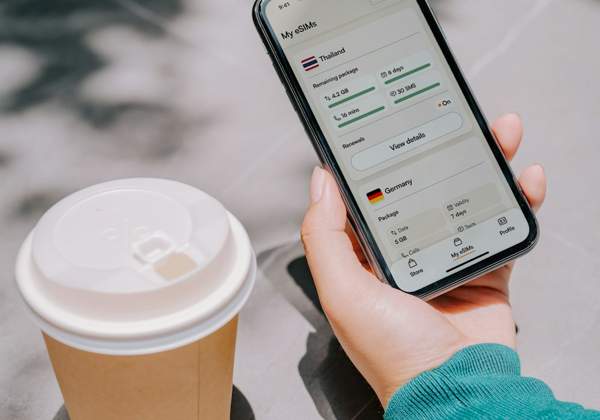
An eSIM adds a line without swapping a physical card. Buy and install it before you fly and you have data from the moment you land — no queue on arrival, and no loose home SIM to lose.
Two conditions apply: your phone must support eSIM, and it must not be carrier-locked.
Whether that second one is a problem depends on where you bought the phone. Several countries have banned the sale of locked handsets outright: the UK since December 2021, Canada since December 2017, Singapore since 1997. Japan's guidelines bar carrier locks on handsets released from 1 October 2021.
The United States is the main exception: carriers there may still sell locked phones. They unlock them under their own policies rather than a general legal duty — broadly, prepaid phones after a year of service, and contract phones once the handset is paid off. A rule requiring every carrier to unlock after 60 days has been before the Federal Communications Commission since August 2024 and has not been adopted. So if your phone came from a US carrier and you are still paying it off, check that it is unlocked before you count on an eSIM.
Roaming is the least effort
For a few days, staying on the plan you already have is the simplest thing you can do.
How it is priced varies. Some plans include an overseas allowance at no extra charge — Rakuten Mobile in Japan, for instance, includes 2GB a month in over 100 countries and territories, Thailand among them, with the speed capped beyond that. Most other carriers charge a flat daily rate instead. Multiply the daily rate by your nights and compare it against a local SIM or an eSIM — for anything beyond a few days, roaming is usually the expensive option.
Wi-Fi is there, but do not rely on it alone
Hotels, cafés and shopping malls often have free wireless. The network name and password are frequently posted on a wall or a sign, and you are free to use it. Where nothing is posted, ask the staff whether there is Wi-Fi — often enough they will tell you, so it is worth asking. But there is no free Wi-Fi while you are moving around, or in a street-food area. You will often want maps or a ride-hailing app, so bring a connection of your own for that.
Four things to sort out before you leave
- Read the INPUT line on your charger. If it says 100-240V, you need no converter
- One plug adapter if you are bringing a three-pin device. If you need a converter, buy it in Thailand rather than carrying one
- Power banks cannot be checked in, and cannot be used in flight. Leaving Japan or Thailand alike. Two per person, ratings legible — check your airline, since the details vary
- Decide how you will connect. A local SIM needs your passport; an eSIM needs a compatible phone
Sources:
- Metropolitan Electricity Authority, "Why does a plug have three pins?" (220 volts in Thailand; warning against removing the earth pin; guidance for two-hole sockets)
- Provincial Electricity Authority, power quality standards (200–240 volts in service, 50 hertz)
- Enforcement Regulation of the Electricity Business Act, Article 38 (Japan's standard voltage of 101V ± 6V)
- Thai industrial standard TIS 166-2549 (plugs and socket-outlets; mandatory from 11 November 2020)
- Civil Aviation Authority of Thailand, Requirement No. 122 on the carriage of lithium batteries on board aircraft, Government Gazette vol. 143, special issue 137 (published 2 June 2026)
- Civil Aviation Authority of Thailand, CAAT NEWS 22/2569, 4 June 2026 (background to the rules and the incidents behind them)
- Civil Aviation Authority of Thailand, FAQ on carrying lithium batteries, 17 July 2026
- Scheduled Airlines Association of Japan, "Updates to the Handling of Power Banks Onboard Aircraft", joint release of 14 April 2026 (applied across member airlines from 24 April 2026; penalties under the Civil Aeronautics Act)
- Republic of Korea, Ministry of Land, Infrastructure and Transport, and the government news service (own rules from March 2025; ICAO-aligned rules from 20 April 2026; ICAO Council approval on 27 March 2026)
- Civil Aviation Authority of Singapore (restrictions on departures from Singapore, from 15 April 2026)
- European Union Aviation Safety Agency (no EU-wide layer above the ICAO technical instructions; airlines add their own conditions)
- US Federal Aviation Administration, PackSafe (nothing above 160Wh, none in checked baggage, no federal rule against in-flight use)
- Emirates and Qatar Airways dangerous goods policies (numbers permitted and in-flight use)
- dtac, "Tourist SIM card registration" (passport required; airport locations)
- Ministry of Internal Affairs and Communications (Japan), guidelines on the distribution and use of mobile handsets (carrier locks barred on handsets released from 1 October 2021)
- 47 CFR 27.16(e) and Federal Communications Commission, Notice of Proposed Rulemaking, WT Docket No. 24-186 (Federal Register, 8 August 2024) — US carrier locking, the proposed 60-day unlocking rule, and the bans in the UK, Canada and Singapore cited therein
- Rakuten Mobile, overseas data roaming (2GB a month at no extra charge)